
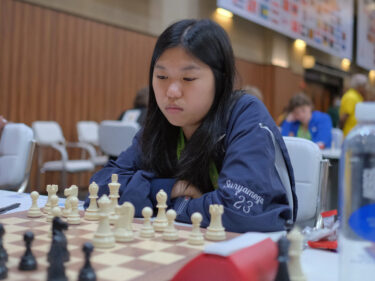
U.S. Schools Recognize Benefits of Chess

Click Image to View the Video Report

US Schools Recognize Benefits of Chess
By Julie Taboh
Washington
26 November 2008

Studies worldwide have shown playing chess has benefits, especially for young children. Inspired by this knowledge, a growing number of teachers in the U.S. are trying to incorporate chess into their students’ lives. VOA correspondent Julie Taboh has more.

Frankie Roth used to be a troubled child. Georgia Clark, the principal at his Maryland school, remembers when she first met him.

“My first impression of Frankie was, we’ve got to do something for him. He is not going to make it,” Clark says. “He was in third grade and having a very difficult time with every adult that he met.”

Clark decided to enroll Frankie in her after-school chess program. She saw a dramatic change in just a few months.

“…When he finally found that he could be successful in chess club, then he just began to blossom,” she says. “And I’ve just seen a great difference in him in the last two years.”

About 30 countries, including Russia, value chess so much that it’s included in school curriculums. Two of the most famous chess champions, Garry Kasparov and Anatoly Karpov, are Russian. The United States has lagged behind.

Now, an increasing number of public schools in the U.S. are offering chess in after-school programs.

Jim Fite is the creator and coach of the chess club at North East Elementary School. He says experts agree about the benefits of chess on children’s brains, even starting at age 2.  Click to Read full article >>

For Teachers and Coaches: A Beginners Guide to Coaching Scholastic Chess

Chess in the WorldDonate to Chess

A Beginners Guide to Coaching Scholastic Chess by Ralph Bowman

Foreword

I started playing tournament Chess in 1962.  I became an educator and began coaching Scholastic Chess in 1970.  I became a tournament director and organizer in 1982. In 1987 I was appointed to the USCF Scholastic Committee and have served each year since, for seven of those years I served as chairperson or co-chairperson.

With that experience I have had many beginning coaches/parents approach me with questions about coaching this wonderful game. What is contained in this book is a compilation of the answers to those questions.

This book is designed with three types of persons in mind:

1) a teacher who has been asked to sponsor a Chess team, 2) parents who want to start a team at the school
for their child and his/her friends, and 3) a Chess player who wants to help a local school but has no experience in either Scholastic Chess or working with schools.

Much of the book is composed of handouts I have given to students and coaches over the years.

To Read the Complete Guide Book Click Here A Beginners Guide to Coaching Scholastic Chess (Ralph Bowman author)

Chess in Education: Chess As a Way to Teach Thinking

Chess Donors

Chess In Education: A Collection of Chess Articles

Today, we delve into another great chess article ! Remember, you can access this and many other chess articles in our Chess Articles Section !

Chess As A Way to Teach Thinking by Diane D. Horgan(Department of Psychology, Memphis State University)

While much recent research on decision-making and problem solving stresses the limits of rationality and how far we humans deviate from “good” decisions, chess is a situation in which humans can make unusually sound decisions.

In fact, young children – not normally known for their rationality – can compete with adults on an even basis and make good decisions that appear rational or analytic.

This raises some very interesting questions for educators: How can children, before reaching the stage of formal operations, think so logically?

Studying the best thinking of which children are capable and how they develop those skills may yield some valuable ideas for educators.

(Full Article) To read more…Click the Link Below.

Chess As A Way To Teach Thinking by Dianne D. Horgan

Scholastics and the Soul of Chess: Is Scholastic Chess Killing Tournament Chess, or, Saving It?

Bert Lerner Elementary Nationals Tournament 2008 Elementary Nationals 2008

Scholastics and the Soul of Chess:  Is Scholastic Chess Killing Tournament Chess, or, Saving It? by Tom Braunlich

The debate about the nature of chess used to be whether it is a sport, an art, or a science.

Now a powerful new group has a different idea: chess is a tool.  An educational tool.  This influential group surprisingly now makes up the majority of USCF members and a large part of the USCF governance, affecting traditional chess in many ways.

The USCF is even now seriously considering an offer by one educational organization to merge with the USCF. The ramifications of these changes for the average adult player are revolutionary, and not necessarily welcome.

The scholastic chess movement has been wonderfully educational for thousands of kids, but it also holds the future of adult tournament chess in its hands and a growing number of players are questioning whether scholastics is doing more harm than good, with concerns in four areas:

  • Scholastics and “Competitiveness”
  • Scholastics and “Talent ”
  • Scholastics and “Money”
  • Scholastics and “Politics”
  • Until I began to research this article I, like most other adult players, didn’t really understand what “scholastic chess” was.  I naively thought it was the same thing as “junior chess,” just better organized than it used to be back when I was a junior in the ‘70sBoy was I wrong!

    To understand the state of chess in America today you must understand the true nature of scholastic chess.

    NOTE: I spent months researching this article on the internet scouring websites and newsgroups, and talking to many prominent scholastic and adult chess organizers and politicians around the country (many of whom are quoted here).  The emphasis is upon scholastics from a national perspective, not on the particular issues we have had recently with scholastics in Oklahoma, although I will sometimes refer to those by way of example.

    Read On!  Click Here to Read Full Article: Scholastics and the Soul of Chess by Tom Braunlich 07/04

    Cognitive Development and Chess for Kindergarten and Pre-K Students

    By WIM Beatriz Marinello

    In the 1970s and 1980s, educators, psycologists and chess aficionados were wondering – At what age can a child be introduced to the game of chess?

    This question was especially interesting because of the theories developed by Jean Piaget.

    Piaget was a Swiss philosopher, natural scientist and developmental psychologist, well known for his work studying children, his theory of cognitive development and for his epistemological view called “genetic epistemology”.

    In 1955, he created the International Centre for Genetic Epistemology in Geneva and directed it until 1980.

    Below are more details regarding Jean Piagets “Theory of Cognitive Development”.

    The Theory of Cognitive Development

    One of the most historically influential theories was developed by Jean Piaget, a Swiss psychologist (1896–1980).

    His theory provided many central concepts in the field of developmental psychology and concerned the growth of intelligence, which for Piaget, meant the ability to more accurately represent the world and perform logical operations on representations of concepts grounded in the world.

    The theory concerns the emergence and acquisition of schemata—schemes of how one perceives the world—in “developmental stages”, times when children are acquiring new ways of mentally representing information.

    The theory is considered “constructivist”, meaning that, unlike nativist theories (which describe cognitive development as the unfolding of innate knowledge and abilities) or empiricist theories (which describe cognitive development as the gradual acquisition of knowledge through experience), it asserts that we construct our cognitive abilities through self-motivated action in the world.

    For his development of the theory, Piaget was awarded the Erasmus Prize.

    Piaget divided schemes that children use to understand the world through four main periods, roughly correlated with and becoming increasingly sophisticated with age:

    • Sensorimotor period (years 0–2)
    • Preoperational period (years 2–6)
    • Concrete operational period (years 6–12)
    • Formal operational period (years 12–adulthood)

    How does this theory impact the game of chess?

    According to Piaget’ studies, children develop the ability to perform concrete operations between ages 6-12.

    Concrete operations’ are characterized as evidence of organized, logical thought. There is the ability to perform multiple classification tasks, order objects in a logical sequence, and comprehend the principle of conservation.

    Thinking becomes less transductive and less egocentric. The child is capable of concrete problem-solving.

    Therefore, there is no question (according to this theory), that children can learn and develop chess skills and knowledge beginning at age 6.

    However, according to Piaget abstract thinking begins later, at age 12.

    Therefore, the skill of analyzing chess moves in advance, as well as visualizing the board and the pieces without moving the pieces, is not possible to perform for children ages 6-12.

    At this point, we all know, this is NOT the case..

    Exposing children to intellectual activities such as learning chess helps develop spatial imagination and abstract thinking.

    Another important question is: Can Kindergarten and Pre-K students learn chess?

    Here, we are talking about children 4 and 5 years of age, who are beginning their first school year.

    In my experience, teaching kinderdarten classes as part of the school curriculum for 14 years, children as young as 4 years old can begin learning the game.

    It is true that the process of teaching chess to students this young requires a slower pace, more repetitive patterns and visually appealing pictures, as well as stories that can engage and motivate students to open their imaginations and desire to learn.

    There are many children, who’s mental structures are already prepared at this age, to perform concrete and abstract operations. It seems to be a natural talent that is built into their brain at a much earlier stage.

    There are no specific studies or research in this area, which I think could help us understand the human brain better, as well as how specific abilities are developed.

    But, the answer to the question remains the same. Can children at such an early age learn the game of chess?

    The answer is …Yes, children at this age can learn and develop chess skills.

    In fact, this is highly recommended, as there is scientific evidence that indicates that at this age, the brain needs to be utilized, presenting a situation where it basically comes down to – using it or losing it.

    There is alot more ground to cover regarding chess for Kindergarten & Pre-K students…such as learning tools, hands on activities, chess curriculum etc…we will discuss those in future blogs.

    This wraps todays blog up…until next time …

    Comments are welcome!

    The Morals of Chess by Benjamin Franklin (Written In 1750)

    Morals of Chess Benjamin FranklinBenjamin Franklin

    NOTE FROM THE EDITOR: This is a wonderful essay written by Benjamin Franklin.
    Benjamin Franklin had the heart of a teacher, which is one of the reasons why he was a great leader and a visionary. Enjoy the read!

    THE MORALS OF CHESS BY BENJAMIN FRANKLIN (1750)

    The game of Chess is not merely an idle amusement. Several very valuable qualities of the mind, useful in the course of human life, are to be acquired or strengthened by it, so as to become habits, ready on all occasions. For life is a kind of chess, in which we have often points to gain, and competitors or adversaries to contend with, and in which there is a vast variety of good and ill events, that are, in some degree, the effects of prudence or the want of it.

    By playing at chess, then, we may learn:

    1. Foresight, which looks a little into futurity, and considers the consequences that may attend to an action: for it is continually occurring to the player, If I move this piece, what will be the advantages of my new situation? What use can my adversary make of it to annoy me? What other moves can I make to support it, and to defend myself from his attacks?”

    2. Circumspection, which surveys the whole chess-board, or scene of action, the relations of the several pieces and situations, the dangers they are respectively exposed to, the several possibilities of their aiding each other; the probabilities that the adversary may make this or that move, and attack this or the other piece; and what different means can be used to avoid his stroke, or turn its consequences against him.

    3. Caution, not to make our moves too hastily. This habit is best acquired by observing strictly the laws of the game, such as, If you touch a piece, you must move it somewhere; if you set it down, you must let it stand. And it is therefore best that these rules should be observed, as the game thereby becomes more the image of human life, and particularly of war; in which, if you have incautiously put yourself into a bad and dangerous position, you cannot obtain your enemys leave to withdraw your troops, and place them more securely; but you must abide by all the consequences of your rashness.

    And lastly, we learn by chess the habit of not being discouraged by present bad appearances in the state of our affairs, the habit of hoping for a favorable change, and that of persevering in the search of resources. The game is so full of events, there is such a variety of turns in it, the fortune of it is so subject to sudden vicissitudes, and one so frequently, after long contemplation, discovers the means of extricating ones self from a supposed insurmountable difficulty, that one is encouraged to continue the contest to the last, in hopes of victory by our own skill, or, at least, of giving a stale mate, by the negligence of our adversary.

    And whoever considers, what in chess he often sees instances of, that particular pieces of success are apt to produce presumption, and its consequent, inattention, by which more is afterwards lost than was gained by the preceding advantage; while misfortunes produce more care and attention, by which the loss may be recovered, will learn not to be too much discouraged by the present success of his adversary, nor to despair of final good fortune, upon every little check he receives in the pursuit of it.

    That we may, therefore, be induced more frequently to chuse this beneficial amusement, in preference to others which are not attended with the same advantages, every circumstance, that may encrease the pleasure of it, should be regarded; and every action or word that is unfair, disrespectful, or that in any way may give uneasiness, should be avoided, as contrary
    to the immediate intention of both the players, which is, to pass the time agreeably.

    Therefore;

    1. If it is agreed to play according the strict rules, then those rules are to be exactly observed by both parties; and should not be insisted on for one side, while deviated from by the other; for this is not equitable.

    2. If it is agreed not to observe the rules exactly, but one party demands indulgences, he should be as willing to allow them to the other.

    3. No false move should ever be made to extricate yourself out of a difficulty, or to gain advantage. There can be no pleasure in playing with a person once detected in such unfair practice.

    4. If your adversary is long in playing, you ought not to hurry him, or express any uneasiness at his delay. You should not sing, or whistle, nor look at your watch, nor take up a book to read, nor make a tapping with your feet on the floor, or with your fingers on the table, nor do any thing that may disturb his attention. For all these things displease. And they do not show in playing, but your craftiness or your rudeness.

    5. You ought not to endeavour to amuse and deceive your adversary, by pretending to have made bad moves, and saying you have now lost the game, in order to make him secure and careless, and inattentive to your schemes; for this is fraud, and deceit, not skill at the game.

    6. You must not, when you have gained a victory, use any triumphing or insulting expression, nor show too much pleasure; but endeavour to console your adversary, and make him less dissatisfied with himself by every kind and civil expression, that may be used with truth; such as, You understand the game better than I, but you are a little inattentive; or, You play too fast; or, You had the best of the game, but something happened to divert your thoughts, and that turned it in my favour.

    7. If you are a spectator, while others play, observe the most perfect silence. For if you give advice, you offend both parties; him, against whom you may give it, because it may cause the loss of his game; him, in whose favour you give it, because, tho it may be good, and he follows it, he loses the pleasure he might have had, if you had permitted him to think till it occurred to himself.

    Even after a move or moves, you must not, by replacing the pieces, show how it might have been played better: for that displeases, and may occasion disputes or doubts about their true situation. All talking to the players, lessens or diverts their attention, and is therefore displeasing; nor should you give the least hint to either party, by any kind of noise or motion. If you do, you are unworthy to be a spectator.-If you have a mind to exercise or show your judgment, do it in playing your own game when you have an opportunity, not in criticizing or meddling with, or counseling, the play of others.

    Lastly, if the game is not to be played rigorously, according to the rules above mentioned, then moderate your desire of victory over your adversary, and be pleased with one over yourself. Snatch not eagerly at every advantage offered by his unskillfulness or inattention; but point out to him kindly that by such a move he places or leaves a piece in danger and unsupported; that by another he will put his king in a dangerous situation, & by this generous civility (so opposite to the unfairness above forbidden) you may indeed happen to lose the game to your opponent, but you will win what is better, his esteem, his respect, and his affection; together with the silent approbation and good will of impartial spectators.

    “Chess Playing Helps Reveal How Brain Works”

    Brain FunctionsBrain Disorders

    CHESS AND THE BRAIN:

    As our knowledge of the brain improves, so does our understanding of what chess can do for its development.

    Below, is an article that may be extremely beneficial, as it provides insights from a neurological standpoint about how the brain works during chess play.

    The benefits of chess are not all highlighted in this article, but, it should shed some light on a subject that still remains obscure to many.

    Chess has long been recognized as a builder of strong intellects, it promotes logical thinking, self-confidence, improves communication and pattern recognition skills, and teaches the values of hard work, concentration, objectivity and commitment, to name a few.

    Surprisingly, today there are still people in education that do not completely comprehend the role chess can play in the school curriculum. It is my hope that this article can help on the road to understanding.

    You can read more on this by visiting our Chess Articles Section for a wide range of articles covering the subject.

    NINDS Website Click Here
    NATIONAL INSTITUTE OF NEUROLOGICAL DISORDERS AND STROKE

    Chess Playing Helps Reveal How Brain Works
    For release: Wednesday, May 18, 1994 / Date Last Modified: Tuesday, March 08, 2005

    Tournament-level chess players are helping scientists at the National Institute of Neurological Disorders and Stroke (NINDS) identify parts of the brain used in complex problem solving. These studies have revealed a processing network that is distributed throughout the brain, according to Dr. Jordan Grafman and his coworkers. Grafman, who heads the Institute’s Cognitive Neuroscience Section, said that chess playing is an ideal model to help scientists better understand the coordinated work of the brain. The study will be published in the May 19 issue of Nature .*

    “Imagine yourself as a chess player about to checkmate your opponent,” Grafman said in describing the work of the brain. “All your knowledge and experience are being retrieved for your next move. First, you perceive the pieces on the board and mentally separate the color-coded pieces. Then you analyze their positions on the board, identify the value of the different pieces, and retrieve the rules of the game for any move. If you are a skilled player like the 10 subjects in this study, you also recognize specific patterns that signify when you have an advantage over your opponent. Finally you have to analyze the consequences of your potential moves and the countermoves of your opponent.”

    A brain imaging technique called positron emission tomography (PET) allowed Grafman and his coworkers to separate these steps and identify the parts of the brain used during each stage. A PET brain scan records the increased use of a radioactive tracer when a part of the brain is activated for a particular task.

    For chess players, color separation and spatial discrimination activate parts on both sides of the brain toward the back of the head known to be associated with visual processing. Rule retrieval activates two parts on the left side of the brain, a small structure deep within the brain associated with indexing memories and a structure in an area near the left ear associated with memory storage. Checkmate judgment activates areas on both sides near the front of the brain crucial for planning and in the back of the brain important for generating images.

    Grafman said experiments like the chess problem are helping improve our understanding of how humans make judgments. According to Grafman, the areas in the front of the brain activated in the checkmate judgment stage may be “managerial knowledge units.” These units are similar to other types of storage in the brain but coordinate a large amount of information in a specific sequence. Grafman said the findings in this study will ultimately be useful in helping people recovering from brain injuries or diseases that affect problem solving and judgment.

    The NINDS is the nation’s principal supporter of research on the brain and nervous system and a lead agency for the Congressionally mandated Decade of the Brain. The Institute supports and conducts a broad program of basic and clinical neurological investigations. The NINDS is part of the National Institutes of Health, located in Bethesda, MD.

    *Nichelli, P., Grafman, J., Pietrini, P., Alway, D., Carton, J. C., Miletich, R. 1994. Brain activity during chess playing. Nature, vol. 369, no. 6477, p. 191.

    Relationship Between Chess, Memory, and Self Esteem by Dr. Robert Ferguson

    Chess Persistence of Memory Salvador Dali

    RELATIONSHIP BETWEEN CHESS AND MEMORY

    Several have surmised that chess not only demands the attribute of memory but also develops it.

    John Artise in Chess and Education writes, Visual stimuli tend to improve memory more than any other stimuli, chess is definitely an excellent memory exerciser the effects of which are transferable to other subjects where memory is necessary.

    According to a two-year study conducted in Kishinev under the management of N.F. Talisina, grades for young students taking part in the chess experiment have gone up in all subjects.

    Teachers noted improvement in memory, better organizational skills, and for many increased fantasy and imagination (Education Ministry of the Moldavian Republic, 1985).

    Development of memory was also claimed in the Venezuela chess program (FIDE Report, 1984, p. 74), which is reviewed in the thinking section; however, no evidence of statistical significance was provided.

    My third study during the 1987-88 school year dealt with both memory and reasoning skills. It is reviewed in the Relationship between Chess and Thinking section.

    RELATIONSHIP BETWEEN CHESS AND SELF-ESTEEM

    While researching the effects of chess, I found an intriguing dissertation written by Harry Milburn Turner in 1971. Entitled An Experiment to Alter Achievement Motivation in Low-Achieving Male Adolescents by Teaching the Game of Chess, Turner’s research attempts to use chess as a tool to motivate low academic ninth grade boys.

    From a rural Georgia junior high school, 66 subjects were identified from a ninth grade class of 403 as underachieving males with no history of failure or acceleration.

    The subjects were not assessed as retarded or emotionally disturbed. The boys academic average for the previous semester was 72 percent or below, and their reading achievement was below the sixth grade level. Sixty of these low achievers were randomly assigned to participate in a teaching experiment. Ninety-two percent of the subjects were African-Americans in a school population which was 70% black.

    The problem was identified as a need to increase success experiences of these boys in order to increase attitudinal changes toward intellectual tasks. It was hypothesized that a positive relationship would exist between the acquisition of a success experience (chess playing skill plus social reinforcement and achievement motivation operationally defined as self-reported changes in attitudes toward achievement in an academic setting.)

    The treatment was six weeks of small group instruction in playing chess, using mastery teaching techniques, and monetary reinforcement. The dependent variables were positive changes in self-reported attitudes conducive to achievement in school.

    These were measured by two self-report instruments known to be positively correlated to achievement in school: the Brookover Self-Concept of Ability Scales (SCA, 1962) and the Childhood Attitude Inventory for Problem Solving (CAPS by Covington and Crutchfield, 1968).

    Analysis was accomplished by using analysis of variance and analysis of covariance with a Solomon 4-group experimental design (Campbell & Stanley, 1965).

    The hypothesis was not fully supported by the data; however, the results were significant at the .01 level on the SCA measure. The treatment was considered effective in maintaining interest, imparting a skill, and generating a feeling of success. Students expressed positive attitudes toward the game, demonstrated proficiency, and 94% of the participants continued to play chess beyond the experiment.

    The conclusion by Dr. Turner was that six weeks was insufficient to affect significant attitudinal changes toward academic achievement by the method employed.

    Other positive chess influences were noted in the Bergen County special education students, who began participating in a chess program in 1983 under the supervision of Carol Ruderman. In the 1986-87 school year, 125 students in nine schools participated.

    Some of the chess classes were held during regular school hours while others were scheduled after school. Most of the students were in grades 4 through 7. According to Carol Ruderman, the program coordinator, nearly all of the pupils (many of whom had adjustment problems and difficulty concentrating) showed a marked improvement in self-concept, concentration, and behavior.

    No attempt was made to quantitatively measure the effect of the chess program, which consisted of thirteen lessons plus playing time (Ruderman, Can Chess Improve Thinking, Social and Organizational Skill in Learning Disabled Students? 1987).

    A study treating students with similar difficulties, The Effect of Learning to Play Chess on Cognitive, Perceptual, and Emotional Development in Children, was done in Brooklyn, New York by Dr. Steven Fried and Dr. Norman Ginsburg (1989).

    The subjects were 30 fourth and fifth grade students who were considered to be mildly delayed in their academic skills.

    The subjects were randomly assigned in equal numbers to one of three treatment conditions, namely, a chess instruction group, a counseling group, or a no-contact group. There were 10 subjects in each group.

    After the 18 week period, all 30 subjects were administered three tests: the picture completion subtest of the Weschler Intelligence Scale for Children Revised, a traditionally recognized, valid and reliable indicator of visual awareness to detail; the block design subtest of the same test, a test which measures spatial-relations skills; and a test called the Survey of School Attitudes measuring school attitude.

    Subjects had 36 meetings during lunch periods over eighteen weeks.

    This study and Turner’s research had the shortest duration of the studies reviewed. In addition, the chess lessons were based on Pawn and Queen & In Between, which is a rather slow-moving program that requires a dozen lessons before a student has been exposed to how all the pieces move.

    In the pretest, the standard one way analysis of variance test revealed no significant differences between the chess, counseling, and no-contact control groups on any of the dependent variables: picture completion, block design, and Survey of School Attitudes.

    Although the primary hypothesis that the chess group would score significantly better than the counseling and the no-contact control group on each of the three tasks was not supported, a trend in the predicted direction was obtained on the picture completion task.

    A significant difference was found in the chess group on the Survey of School Attitudes (p<.05).

    Another program similar to Rudermans, Utilizing Chess to Promote Self-Esteem in Perceptually Impaired Students, (Levy, 1987) is a part of the curriculum that has been used since 1981 in Bill Levy’s self-contained class of perceptually-impaired sixth, seventh, and eighth grade pupils in Hopatcong Middle School, Hopatcong, New Jersey.

    The three components of this program are: 1) students are taught chess, 2) chess-related packets are distributed to students during the year, and 3) ten additional chess activities are used throughout the year.

    The purpose of Levy’s program is to develop learning disabled students self-esteem and confidence.

    Students were given repeated opportunities in their self-contained classroom to demonstrate that they could achieve success in critical thinking activities. They also joined the school chess club.

    In the 1986-87 school year, Levy decided to make a more formal assessment of the value of his program by using pre and posttests to measure gains. He used the Piers-Harris Children’s Self-Concept Scale and The Way I Feel About Myself.

    The instruments were administered in September 1986 and again in June 1987. In addition, another teacher assessed students self-concept at the beginning and the end of the year using E.L. McDaniels Inferred Self-Concept Scale.

    The raw scores on both tests showed improvement in individual and class self-esteem. Thirteen of the fourteen students involved showed improvement. Progress was also shown after one year in critical thinking, socialization, and academic achievement.

    Strong evidence exists among the studies by Turner, Ruderman, Fried, Ginsburg, and Levy for supporting chess programs to develop self-esteem, but the emphasis in my studies deals more with Levy’s finding that chess improves thinking skills.

    Chess and Standard Test Scores

    In the Chess Zone A Thumbs Up for Chess at Henry Clay School ! Chess Success at Henry Clay !

    Chess and Standard Test Scores by James M. Liptrap

    Summary: Regular (non-honors) Elementary students who participated in a school chess club showed twice the improvement of non-chessplayers in Reading and Mathematics between third and fifth grades on the Texas Assessment of Academic Skills.

    In fifth grade, regular-track chessplayers scored 4.3 TLI points higher in reading (pg < .01) and 6.4 points higher in math (pg < .00001) than non-chessplayers.

    The purpose of this study is to document the effect of participation in a chess club upon the standardized test scores of elementary school students.

    The study was conducted in four of the elementary schools in a large suburban school district near Houston, Texas.  It compared the third and fifth grade scores on the Texas Assessment of Academic Skills (TAAS) of students who participated in a school chess club in fourth and/or fifth grade with the scores of students who did not participate in a chess club.

    Significant improvement in math and reading scores were found among the regular track chess students.

    Background: Previous studies indicating the effects of chess on scholastic achievement have received little notice, and have been criticized for small sample size , or for chess clubs being self-selective elite groups, or for being too anecdotal.

    Many observations by teachers, parents, administrators, and students report advantages of participation in chess, based principally upon improved self-image, confidence, and critical thinking skills.

    As reported in “Developing Critical and Creative Thinking Through Chess”, Robert Ferguson (of Bradford, Pennsylvania), tested students from seventh to ninth grades,  (1979-1983), as part of the ESEA Title IV-C Explore Program , and found:

    Watson-Glaser Critical Thinking Appraisal (Average Annual Increase):

    Chess 17.3%; Non-Chess 4.6%

    Torrance Tests of Creative Thinking:

    Fluency: Chess 19.9% Non-Chess 6.0%
    Flexibility:
    Chess 22.8% Non-Chess 9.5%
    Originality:
    Chess 70.0% Non-Chess 34.8%

    The mathematics curriculum in New Brunswick, Canada, is a text series called Challenging Mathematics, which uses chess to teach logic from grades 2 to 7.

    Using this curriculum, the average problem-solving score of pupils in the province increased from 62% to 81%.

    Reports from students, teachers, and parents not only extol the academic benefits of chess on math problem solving skills and reading comprehension , but also report increased self-confidence, patience, memory, logic, critical thinking, observation, analysis, creativity, concentration, persistence, self-control, sportsmanship, responsibility, respect for others, self esteem, coping with frustration, and many other positive influences which are difficult to measure but can make a great difference in student attitude, motivation and achievement.

    Continue Reading…Click Here to Read Complete Article: Chess and Standard Test Scores

    The Samford Fellowship Awards Featured in a NY Times Article

    Vinay Bhat Vinay Bhat vs Irina Krush Chess Life Magazine

    New York Times

    The New York Times featured an article about the Samford Fellowship Awards.

    The article titled “Award Helps Young Players to Compete, and Pay the Bills” was written By Dylan Loeb McClain and Published on April 27, 2008

    “To make a living at chess, top players have to be successful enough to live off their tournament winnings or income from teaching or coaching.” (Click Here to Read the NY Times Article)

    Frank P. Samford, Jr. Chess Fellowship Press Release

    2008 Samford Fellowship Awarded to Krush and Bhat

    Contact: Allen Kaufman
    (718) 544-5036
    AllenKauf@aol.com

    For the first time in its twenty-two year history, two full Samford Fellowships have been awarded in a single year. The applicants this year included an unusually large number of highly qualified chessmasters. Because two of them, Irina Krush and Vinay Bhat, are in their last year of eligibility (both are 24) it was decided to award both the 2008 and 2009 Samford Fellowships this year.

    The winners were chosen by the Samford Fellowship Committee, consisting of Frank P. Samford III (son of Samford Fellowship founder Frank P. Samford, Jr.), former U.S. Chess Champion Grandmaster Arthur Bisguier and International Master John Donaldson. The winner’s potential was determined based on his chess talent, work ethic, dedication and accomplishments.

    The late Frank P. Samford, Jr. of Birmingham, Alabama, was a distinguished attorney and CEO of Liberty National Life Insurance Company (now Torchmark). Mr. Samford was active in civic, business, political, educational and cultural affairs. He was also an enthusiastic competitor in chess tournaments.

    Mr. Samford created the Samford Fellowship to identify and assist the best American chessmasters under the age of twenty-five by providing top level coaching, strong competition and access to study materials. The Fellowship also provides a monthly stipend for living expenses so that the winners may devote themselves entirely to chess without having financial worries. The total value of the two-year Fellowship is approximately $36,000 annually.  The program is administered by Barbara De Maro for the U. S. Chess Trust.

    Generous contributions from Mrs. Virginia Samford and Torchmark Corporation support the Fellowship. The Samford Fellowship is a fitting memorial to an extraordinary man. The dedication, creativity and achievement that marked Mr. Frank P. Samford, Jr.’s life are examples for all chessplayers to admire and emulate.

    International master (IM) Irina Krush is the reigning U.S. Women’s Champion, with a USCF rating of 2515 and a FIDE rating of 2479. Irina has represented the U.S. in numerous international competitions since the age of seven, receiving medals in both World Youth and World Junior Championships. She became a master at age twelve, and an International Master at age sixteen. She has been an integral part of the U.S. Women’s Olympiad Team since the age of fourteen, helping the U.S. win a historic silver medal at the 2004 Olympiad in Mallorca, Spain.

    At just fourteen, she won her first U.S. Women’s title with the convincing score of 8.5/9. At seventeen, she tied for first place with GM Igor Novikov in the NYC Mayor’s Cup and earned her first grandmaster norm. Irina is also active in the chess community as a writer, photographer, teacher, and manager of the U.S. Chess League team, the New York Knights.

    Vinay Bhat learned how to play chess when he was six-and-a-half years old. At the age of ten-and-a-half he set the then-current record for becoming the youngest national master, breaking Bobby Fischer’s record by two years. That record was since broken by Hikaru Nakamura, and most recently, by Nicholas Nip. Vinay also played extensively internationally, representing the US in nine different World Youth competitions with top five finishes on five different occasions. Vinay completed his IM title in 2000. From 2002 through 2006, he attended the University of California at Berkeley, graduating with degrees in Statistics and Political Economy, and then went on to work at Cornerstone Research in Menlo Park, California. While working he has gotten back to playing chess and won his third and final GM norm in July 2007. Later that year, FIDE granted him the GM title conditional on his FIDE rating crossing 2500.

    Frank P. Samford, Jr. Chess Fellowship

    The following two fine games were won by the new Samford Fellows:

    Isbank Ataturk International Women Masters Tournament, Istanbul March 11, 2008

    White: Krush Irina (IM)
    Black: Chen Zhu (GM) the 2001 Women’s World Champion

    1. d4 d5 2. c4 c6 3. Nf3 Nf6 4. Nc3 dxc4 5. e4 b5 6. e5 Nd5 7. a4 e6 8. Ng5 Be7 9. h4 h6 10. Nge4 b4 11. Nb1 Ba6 12. Qg4 Kf8 13. Nbd2 b3 14. Bxc4 Nb4 15. O-O Bxc4 16. Nxc4 Qxd4 17. Qe2 Qd3 18. Qxd3 Nxd3 19. Rd1 Nb4 20. Ra3 Nd5 21. Rxb3 Nd7 22. Rb7 N7b6 23. b3 Bxh4 24. Ba3+ Kg8 25. Na5 f5 26. exf6 gxf6 27. g3 Bg5 28. f4 f5 29. fxg5 fxe4 30. g6 Re8 31. Nxc6 e3 32. Bb2 e5 33. Bxe5 Rxe5 34.Nxe5 h5 35. Rf1 1-0

    Koltanowski Memorial Tournament, San Francisco December 18, 2000

    White: Jaan Ehlvest (GM)
    Black: Vinay S Bhat (IM)

    1. e4 e6 2. d4 d5 3. e5 c5 4. c3 Nc6 5. Nf3 Nh6 6. a3 Nf5 7. b4 cxd4 8. cxd4 Qb6 9. Be3 g6 10. Bd3 Nxe3 11. fxe3 Bh6 12. Qe2 Bd7 13. Nbd2 a5 14. b5 Ne7 15. g4 a4 16. O-O O-O 17. h4 Rac8 18. h5 gxh5 19. g5 Bg7 20. Kf2 Rc3 21. Rh1 Nf5 22. Ne1 h4 23. Qh5 Bxe5 24. Kg2 Bg3 25. Ndf3 26. Nxe3+ Kg1 Nf5 27. Rd1 e5 0-1